


Friday, 6 May 2011
Philippines Arrests Suspected Terrorist Linked to al-Qaida
The Philippines police have arrested a suspected member of the terrorist group Abu Sayyaf, who had been working as security guard in the capital.
The police said Friday that Arabani Jakiran was arrested Thursday at the plush Manila condominium where he worked as a security guard. Jakiran is suspected of taking part in the abduction of hospital staff in the southern island of Basilan in 2001. Some of the captives were killed as police hunted down the kidnappers.
Abu Sayyaf, which claimed to be fighting for a Muslim homeland in the southern Philippines, became best known for a series of kidnappings for ransom. Police and Southeast Asia terrorism experts say the group has links to both the al-Qaida network led by Osama bin Laden and the Jemaah Islamiyah Islamic militants based in Indonesia.
Police officials say the arrest was part of a new crackdown on members of Abu Sayyaf and members of Jemaah Islamiyah living in the country.
Also Friday, police in Manila blocked a planned march to the U.S. Embassy to protest the killing of Osama bin Laden earlier this week in Pakistan by U.S. Navy SEALs. About 70 protesters, who gathered after Friday prayers at a mosque in the city, disbanded peacefully afterward.
The Philippines has a predominately Christian population but it has a large Muslim minority, mostly living in the country's southern islands.
Former Taliban fighter manned an Islamic bookstall while trying to drum up recruits for jihad in Afghanistan
Former Taliban fighter manned an Islamic bookstall while trying to drum up recruits for jihad in Afghanistan
No comments
:
Former Taliban fighter manned an Islamic bookstall while trying to drum up recruits for jihad in Afghanistan, a British prosecutor alleged Thursday.
Andrew Edis said Pakistani-born Munir Farooqi, 54, was one of several extremists who manned the bookstall in the northern English city of Manchester in the hope of enrolling holy warriors to their cause.
"This was an organized attempt taking place in Manchester to raise men for the jihad, to recruit fighters," Edis told a jury at Manchester Crown Court. He said that meant persuading people "that their religious duty requires them to fight, to kill, and to die."
Edis said the recruits would be expected to attend "training camps and battlefields abroad, principally in Afghanistan," and that, as a Taliban veteran, Farooqi would have had the "know how and contacts" to get willing fighters to the area.
But Edis said Farooqi's efforts foundered when two of his recruits turned out to be undercover policemen.
The men, identified only by the pseudonyms Ray and Simon, approached Farooqi in October 2008, pretending to be at a low ebb in their lives and interested in Islam. The officers secretly recorded him as he, his 27-year-old son Harris, and two others — British Muslim convert Matthew Newton, 29, and former youth offender Israr Malik, 22 — attempted to radicalize them, Edis said.
The men were eventually arrested in a counterterrorism operation on November 16, 2009.
All four deny the charges being leveled against them, but have yet to present their case.
Up to 15 people were killed and some 60 others wounded in suicide car bomb attack on a group of a police force Thursday morning in Iraq's central city of Hillah
Up to 15 people were killed and some 60 others wounded in suicide car bomb attack on a group of a police force Thursday morning in Iraq's central city of Hillah
No comments
:
Up to 15 people were killed and some 60 others wounded in suicide car bomb attack on a group of a police force Thursday morning in Iraq's central city of Hillah, a local police source said.
"The latest reports said that 15 were killed and 60 wounded by the suicide car bomb attack in the city of Hillah," the source from Hialla police told Xinhua on condition of anonymity because he was not authorized to speak to the media.
The attack occurred in the center of Hillah, the capital city of Babylon province which locates some 90 km south of Baghdad, when the police were on a morning shift, the source said.
Many of the killed and wounded were policemen and several cars and nearby shops were damaged in the blast, he said, adding the police force has cordoned off the area for investigation.
The attack came as the Iraqi security forces increased security alert in Baghdad and other Iraqi cities as they expect deadly attacks to be carried out by Qaida militants in retaliation for the killing of al-Qaida head Osama Bin Laden in Pakistan.
Violence and sporadic high-profile bomb attacks continue in the Iraqi cities despite the dramatic decrease of violence over the last three years.
planned rail attack on the tenth anniversary of September the 11th.
US government officials say they have found evidence in Osama bin Laden’s hideout of a planned rail attack on the tenth anniversary of September the 11th. The Department of Homeland Security claims to have intelligence indicating that the Al Qaeda leader discussed targeting a train within America.
The agency has been reviewing information found inside the Pakistani compound since the night raid and killing of bin Laden earlier in the week. Officials say what they have discovered since storming the hideout indicates one tactic might have been to somehow tip a train off its tracks. However, no concrete plans for such an attack have been found.
Meanwhile, relations between the US and Pakistan are still under strain, with attitudes towards America hardening in the wake of operation by the Navy Seals. Pakistan’s army is threatening to reconsider its anti-terror cooperation with Washington if another similar assault takes place, which Islamabad says violated its sovereignty.
Photographs acquired by Reuters and taken about an hour after the U.S. assault on Osama bin Laden's compound in Abbottabad in Pakistan show three dead men lying in pools of blood, but no weapons.
but no weapons.
,
Photographs acquired by Reuters and taken about an hour after the U.S. assault on Osama bin Laden's compound in Abbottabad in Pakistan show three dead men lying in pools of blood
No comments
:
Photographs acquired by Reuters and taken about an hour after the U.S. assault on Osama bin Laden's compound in Abbottabad in Pakistan show three dead men lying in pools of blood, but no weapons.
The photos, taken by a Pakistani security official who entered the compound after the early morning raid on Monday, show two men dressed in traditional Pakistani garb and one in a t-shirt, with blood streaming from their ears, noses and mouths.
[View the photographs in the module to the left. Warning - they include graphic and disturbing content.]
The official, who wished to remain anonymous, sold the pictures to Reuters.
None of the men looked like bin Laden. President Barack Obama decided not to release photos of his body because it could have incited violence and be used as an al Qaeda propaganda tool.
"I think that given the graphic nature of these photos, it would create some national security risk," Obama told the CBS program "60 Minutes."
Based on the time-stamps on the pictures, the earliest one was dated May 2, 2:30 a.m., approximately an hour after the completion of the raid in which bin Laden was killed.
Other photos, taken hours later at between 5:21 a.m. and 6:43 a.m. show the outside of the trash-strewn compound and the wreckage of the helicopter the United States abandoned. The tail assembly is unusual, and could indicate some kind of previously unknown stealth capability.
Reuters is confident of the authenticity of the purchased images because details in the photos appear to show a wrecked helicopter from the assault, matching details from photos taken independently on Monday.
U.S. forces lost a helicopter in the raid due to a mechanical problem and later destroyed it.
The pictures are also taken in sequence and are all the same size in pixels, indicating they have not been tampered with. The time and date in the photos as recorded in the digital file's metadata match lighting conditions for the area as well as the time and date imprinted on the image itself.
The close-cropped pictures do not show any weapons on the dead men, but the photos are taken in medium close-up and often crop out the men's hands and arms.
One photo shows a computer cable and what looks like a child's plastic green and orange water pistol lying under the right shoulder of one of the dead men. A large pool of blood has formed under his head.
A second shows another man with a streak of blood running from his nose across his right cheek and a large band of blood across his chest.
A third man, in a T-shirt, is on his back in a large pool of blood which appears to be from a head wound.
U.S. acknowledgment on Tuesday that bin Laden was unarmed when shot dead had raised accusations Washington had violated international law. The exact circumstances of his death remained unclear and could yet fuel controversy, especially in the Muslim world.
Pakistan faced national embarrassment, a leading Islamabad newspaper said, in explaining how the world's most-wanted man was able to live for years in the military garrison town of Abbottabad, just north of the capital.
Pakistan blamed worldwide intelligence lapses for a failure to detect bin Laden, while Washington worked to establish whether its ally had sheltered the al Qaeda leader, which Islamabad vehemently denies.
Morocco's interior minister has rocked the country's flourishing tourist industry by claiming there could be further terrorist attacks following last week's Marrakech bombing.
Morocco's interior minister has rocked the country's flourishing tourist industry by claiming there could be further terrorist attacks following last week's Marrakech bombing.
No comments
:
Speaking after the bomb attack which killed 16, including 14 foreigners, at a popular cafe in the historic Djemma el Fna square, Tajeb Cherkaoui has admitted there 'is a possibility of more dangers to come'.
Many details of the attack are still unknown, but it was widely believed to have been targeted at foreign tourists as the square, which is packed at night with markets stalls, dancers and snake charmers, is considered a must-see for visitors to the city.
Devastated: The bomb attack in Marrakech will affect the city's burgeoning tourism trade
The Foreign and Commonwealth Office has said there is 'a high threat of terrorism' in the country following the latest bombing and adds that 'attacks could be indiscriminate, including in places frequented by expatriates and foreign travellers'.
Holidaymakers are advised to 'maintain a high level of vigilance'.
Holiday company Kuoni confirmed it will continue to operate as normal but said it is in close contact with ground agents to ensure the utmost safety for customers.
The bombing struck at the heart of Morocco's burgeoning tourism industry, which is the second biggest employer in the country after agriculture.
Visitor numbers have grown two-fold in less than a decade and arrivals went up by six per cent in 2009, when the rest of the world was suffering a decline due to the recession.
Around 9.3 million people visited Morocco in 2010 and the second instalment of the Sex and the City franchise was filmed in Marrakech, sending interest in city breaks soaring.
However, the fear of further attacks could reverse Morocco's good fortune.
Tourism Minister Yassir Znagui has visited the 25 people injured in the bombing in hospital and admitted it was 'difficult to talk about the consequences' on future visitors.
'For the moment, the priority is to be near the victims and their relatives,' he said.
Thursday, 5 May 2011
Yemeni-American cleric Anwar al-Awlaki, who is a top propagandist for Al-Qaeda, has outlined a plan to carry out a 26/11 Mumbai-style massacre in the United Kingdom
has outlined a plan to carry out a 26/11 Mumbai-style massacre in the United Kingdom
,
who is a top propagandist for Al-Qaeda
,
Yemeni-American cleric Anwar al-Awlaki
No comments
:
Yemeni-American cleric Anwar al-Awlaki, who is a top propagandist for Al-Qaeda, has outlined a plan to carry out a 26/11 Mumbai-style massacre in the United Kingdom in an email sent to British tabloid The Sun.
The email was sent after the tabloid's investigator, posing as a UK-based fanatic named "Q. Khan", contacted Awlaki in a sting operation.
"We ask Allah to give you the strength and steadfastness to serve His religion. If you are a group of brothers who trust each other then you may work together. Otherwise we advise you to work alone. In case you decide to work together then it is definitely better to go all at once," the tabloid quoted Awlaki, as saying in an email.
"The options that you have for operations could be pipe bombs, assassinations or using a firearm at a location crowded with enemies," it added.
The email was signed: "Your brothers at Al-Qaeda of the Arabian Peninsula".
Meanwhile, MI6 agents are studying the dossier.
British counter-terrorism officials have been warning about the threat of a Mumbai-style attack on major cities for two years.
The attacks, which began on 26 November and lasted until 29 November, 2008, took the lives of 164 people and wounded at least 308 others.
Four police officers violently assaulted a terror suspect in front of his wife and continued to do so after he had been handcuffed and restrained,
Four police officers violently assaulted a terror suspect in front of his wife and continued to do so after he had been handcuffed and restrained
No comments
:
Four police officers violently assaulted a terror suspect in front of his wife and continued to do so after he had been handcuffed and restrained, a court heard yesterday.
Constables Mark Jones, 43, Roderick James-Bowen, 40, Nigel Cowley, 33 and Detective Constable John Donohue, 36, sat in the dock as the jury was played a secret audio recording of their alleged ttack on terror suspect Babar Ahmad during the arrest at his home in Tooting, south London, in December 2003.
They are charged with assault, committed in the course of the arrest.
The court heard the recording, made by a "probe" secretly placed in the property by the intelligence services, in which Mr Ahmad can be heard screaming in pain.
"They administered a very violent assault: in effect, they gave him a beating or they beat him up," said Jonathan Laidlaw QC, prosecuting.
The officers, part of the Metropolitan Police's Territorial Support Group, were dressed in helmets and protective clothing and carrying batons and CS spray, when they smashed into Mr Ahmad's home before dawn on 2 December 2003. They had been briefed before the raid that Mr Ahmad had received terrorist training, including firearms training, had fought overseas in support of Jihad and was in the advanced stages of martial arts training. They were warned of the dangers he posed and reminded of the death of Detective Constable Stephen Oake, who was stabbed to death in Manchester earlier that year in a similar raid.
"The reality was quite different," Mr Laidlaw said. The jury heard that Mr Ahmad was launched into the window, smashing it, knocking him to the ground where he was punched and kicked repeatedly, as the officers shouted, "Get down! Get down you fucking bastard," and called him "a fucking cunt", ignoring his wife's pleas to leave him alone.
He was then taken into a prayer room on the ground floor of his home, where he was forced into a praying position, while the officers shouted "Where is your God now?" before removing his pyjama bottoms and grabbing his genitals. As he was led to the van the officers stamped down on his bare feet, the court was told. The officers deny the charges. Mr Laidlaw said that the officers will claim that over 70 injuries to Mr Ahmad's head, neck, wrists and feet were sustained in the initial knock into the window and then during his transfer to Charing Cross police station. Mr Ahmad was released without charge six days after his arrest but has been in custody since 2004, awaiting extradition to America for alleged terrorism offences – the longest any British citizen has been held without trial on terrorism charges.
Mr Laidlaw said: "The officer [in the van] sitting nearest to Mr Ahmad's head asked him where he was born and when he replied London, that officer punched him in the back of the head. The same officer then... held him in a headlock. After releasing him [the officer] said: 'You fucking cunt, you'll remember this day for the rest of your life'." Mr Ahmad will appear as a witness today.
Pictures taken shortly after the raid that killed al Qaeda leader Osama bin Laden show three men lying dead in pools of blood and the wreckage of a U.S. helicopter abandoned during the assault.
Pictures taken shortly after the raid that killed al Qaeda leader Osama bin Laden show three men lying dead in pools of blood and the wreckage of a U.S. helicopter abandoned during the assault.
No comments
:
Pictures taken shortly after the raid that killed al Qaeda leader Osama bin Laden show three men lying dead in pools of blood and the wreckage of a U.S. helicopter abandoned during the assault.
One of the dead men bears a family resemblance to bin Laden, but there was no confirmation of his identity. The al Qaeda leader's adult son was among those killed in Monday's attack by U.S. commandos, according to American officials.
The pictures were published Wednesday by Reuters. The news agency says they were taken by a Pakistani security official about an hour after U.S. forces left bin Laden's compound and that it is confident of the authenticity of the purchased images.
Clad in a T-shirt, the man who resembles bin Laden lies in a large pool of blood that appears to spread from the back of his head. Two other men, dressed in Pakistani clothing, appear to have died from extensive head and chest wounds.
Sources have named the courier who lived at the compound as al Qaeda veteran Sheikh Abu Ahmad -- a Kuwaiti citizen of Pakistani descent.
Other photos, taken at dawn on Monday show the wreckage of the helicopter the U.S Navy SEAL team had to leave behind after a crash-landing. Experts said the tail assembly is different from known helicopter types and could indicate some kind of previously unknown capability to avoid radar, they said.
In particular, the tail features a cowling that might have been designed to reduce rotor noise levels, they said.
Pakistan has already said that the helicopters used in the raid took advantage of blind spots in radar coverage to penetrate deep into its territory undetected.
Tuesday, 3 May 2011
Counter-terror detectives have raided a string of houses after five men were arrested close to the Sellafield nuclear site in Cumbria.
Sky sources said it is understood the men being held were British Asians and were taking photographs of the plant.
Four houses were raided today in east London following the arrests at about 4.30pm on Monday.
The men were detained under section 41 of the Terrorism Act after a stop check on a vehicle.
The five, all in their 20s and from London, were held overnight at a police station in Carlisle.
The investigation is being led by counter-terrorism officers in Manchester.
Sky's home affairs correspondent Mark White said: "From what I understand there was nothing found on them that would give immediate cause for concern that there was any potential attack."
A spokesman for Greater Manchester Police (GMP) said the investigation was in its early stages and no further information would be released yet.
The location and timing of the incident, which came hours after news broke that Osama bin Laden had been killed by US special forces, is likely to cause concern.
Police said there was no evidence of a connection to the events in Pakistan, but the Government has urged the public to remain vigilant.
According to reports last year, a counter-terrorism review of Britain's nuclear power plants was carried out after fears arose over safety at Sellafield.
The Sellafield site - responsible for decommissioning and reprocessing nuclear waste, and fuel manufacturing - is heavily protected by private security and officers from the Civil Nuclear Constabulary, some of whom are armed.
Section 41 of the Terrorism Act 2000 allows a police officer to arrest any person who is "reasonably suspected" of being a terrorist.
FIVE men have been arrested near the Sellafield nuclear plant in Cumbria, northwestern England under the Terrorism Act.
FIVE men have been arrested near the Sellafield nuclear plant in Cumbria
,
northwestern England under the Terrorism Act.
No comments
:
Local police said a stop check on a vehicle by the Civil Nuclear Constabulary on Monday at 4.32pm local time led to the arrests of the men, who are in their 20s and all from London. The BBC reported they were of Bangladeshi origin.
Sky News sources suggested the officers became suspicious after seeing the men filming or photographing around the plant.
British anti-terrorism police were now investigating, Cumbria police said.
The men were taken into custody overnight in Carlisle and were being transferred to Manchester. Under the terms of section 41 of the UK's Terrorism Act they can be held on suspicion of terrorist offenses for 48 hours without charge.
The arrests came just hours after news of the death of al-Qa'ida leader Osama bin Laden, which led to warnings from the Prime Minister David Cameron for the British public to remain vigilant to the risk of reprisals.
However police said for the moment they were "not aware of any connection to recent events in Pakistan".
The Sellafield plant, which last year completed the construction of a bunker to store 100 tonnes of raw plutonium, has been the subject of a recent security review ordered by UK government ministers.
The facility holds enough plutonium to build thousands of nuclear bombs, which terror experts believe make it an even greater target for a potential extremist attack.
The review of all of Britain's nuclear facilities came after the discovery of security weaknesses at the giant Sellafield reprocessing site. Exact details were not disclosed but security sources denied there had been any breach at Sellafield by intruders.
An east London al-Qa'ida cell that was foiled in a 2006 plot to blow up transatlantic airliners in mid-flight, also had in its possession an alternative target list of nuclear power stations, oil and gas terminals and undersea pipelines.
American officials said last night they were ‘99.9 per cent confident’ that DNA evidence proved Osama bin Laden is dead.
Photos of the corpse have also been passed to experts in facial recognition
,
who are comparing them to previous indisputable images of the Al Qaeda leader.
No comments
:
Scientists compared forensic samples from the body in the Pakistan hideout with those taken from the brain of the terror mastermind’s late sister.
Photos of the corpse have also been passed to experts in facial recognition, who are comparing them to previous indisputable images of the Al Qaeda leader.
America has carried out such tests before on tissue samples from unrecognisable victims of drone bombing attacks on remote Afghan and Pakistani terror nests, who it was thought might have been Bin Laden.
The apparent speed of the Bin Laden tests raised yet more questions about the U.S. operation last night. Merely transporting samples to laboratories where DNA profiling can be carried out usually takes time, as does the process itself.
However, new technology means that the process can be speeded up and it is entirely possible that the Americans kept a bin Laden family DNA profile at one of their bases in Afghanistan. Indeed, one report yesterday was that the DNA test had already been conducted on the fresh corpse.
Dr Frederick Bieber, a medical geneticist at Brigham and Women's Hospital, told the LA Times that it was possible for DNA analysis to be done quickly, particularly if profiles of relatives had already been analysed.
'Often it can be done overnight, and in high-profile forensic investigations, it often is,' said Bieber.
Pentagon officials said that photos of the body and a videotape of the sea burial may be released soon to answer doubts that bin Laden was actually killed.
Monday, 2 May 2011
Described by US officials as "extraordinarily unique" the compound housing the terrorist leader was more like a fortress than a residential dwelling.
we were shocked by what we saw – an extraordinarily unique compound
,
When we saw the compound
No comments
:
Described by US officials as "extraordinarily unique" the compound housing the terrorist leader was more like a fortress than a residential dwelling.
Surrounded by 18ft walls topped by barbed wire, the only access was through two security gates.
Built around five years ago at an estimated cost of £600,000, its accommodation block is three storey's tall.
Such is the emphasis on privacy that even the third-floor terrace is shielded by a seven-foot wall.
Inside officials said the house was sectioned up – and may have even been designed to hide a secret home within a home.
"When we saw the compound, we were shocked by what we saw – an extraordinarily unique compound," the US officials said.
"The physical security measures of the compound are extraordinary."
But what really provoked their suspicions was that while neighbours left their bins out to be collected, residents of the compound burned their rubbish on site, the officials said.
Despite its size, the "owner" who aided bin Laden – who was linked to the property by US intelligence agents – and his brother had "no explainable source of wealth".
The property also had no telephone or internet services associated with it.
"Intelligence analysts concluded that this compound was custom-built to hide someone of significance," said the official.
"Our best assessment, based on a large body of reporting from multiple sources, was that bin Laden was living there with several family members, including his youngest wife.
"Everything we saw – the extremely elaborate operational security, the brothers' background and their behaviour, and the location and the design of the compound itself, was perfectly consistent with what our experts expected bin Laden's hideout to look like.
"Our analysts looked at this from every angle, considering carefully who other than bin Laden could be at the compound.
"We had high confidence that a high-value target was being harboured by the brothers on the compound, and we assessed that there was a strong probability that that person was Osama bin Laden."
Locals said large Landcruisers and other expensive cars were seen driving into the compound, which is in a regular middle-class neighbourhood.
Salman Riaz, a film actor, said that five months ago he and a crew tried to do some filming next to the house, but were told to stop by two men who came out.
"They told me that this is haram (forbidden in Islam)," he said.
Residents said they were astounded to learn bin Laden had been in their midst. One neighbour said an old man had been living in the compound.
"He never mixed much, he kept a low profile," said the neighbour, Zahoor Ahmed.
"It's hard to believe bin Laden was there. We never saw any extraordinary movements," said another neighbour, Address Ahmed.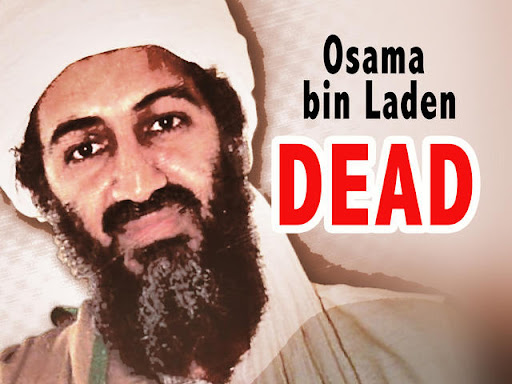
DNA Test Match Proves Bin Laden Death
Osama bin Laden's death has been confirmed by DNA tests that show a "virtually 100%" match with the al Qaeda leader
Officials said his body had also been identified by a woman believed to be one of his wives.
No comments
:
Osama bin Laden's death has been confirmed by DNA tests that show a "virtually 100%" match with the al Qaeda leader, US officials have revealed.
The world's most-wanted man was buried at sea in the early hours of the morning, after he was killed by a gunshot to the head at a villa in the Pakistani town of Abbottabad.
Officials said his body had also been identified by a woman believed to be one of his wives.
US President Barack Obama said: "The world is safer, it is a better place because of the death of Osama bin Laden."
A US defence official said Bin Laden was given an Islamic funeral, which involved him being wrapped in a white sheet and washed before being sent overboard.
This does not eliminate al Qaeda but it does eliminate their iconic mastermind. It will help eliminate any questions about the the commitment of the US relating to the war on terrorism.
Sky News blogger Jon-Christopher Bua
They said the ceremony took place at sea because other countries - including Saudi Arabia and Pakistan - refused to take custody of the body.
US chief counter-terrorism advisor John Brennan insisted Bin Laden would have been taken alive if there had been the opportunity.
That contradicted sources that had previously claimed the operation had been a "kill mission", with no attempt to capture the target.
Osama bin Laden killed after tip-off from his deputy
Khalid Sheikh Mohammed (KSM), who was repeatedly subjected to methods including “waterboarding” and stress positions, provided the CIA with the name of bin Laden’s personal courier, according to US officials.
A second source – also an al-Qaeda “leader” held at Guantanamo Bay – then confirmed the courier’s identity, sparking an intense manhunt that resulted in the dramatic final raid.
Secret documents seen by The Daily Telegraph disclose that this second source – the terrorist operations chief, Abu Faraj al-Libi – played a key role in finding “safe havens” for bin Laden and lived in the small, military town where he was finally found.
The killing of the world’s most wanted man as a direct result of information obtained from Guantanamo detainees such as KSM will reignite the debate over whether torture is a legitimate interrogation technique in the "war on terror". Both KSM and al-Libi were subjected to harsh techniques during their interrogations in CIA prisons.
Amnesty International has already warned that the killing of bin Laden must not be used as evidence that torture is “justifiable”.
Bin Laden went into hiding shortly after the 9/11 attacks and the White House has been criticised for a series of failures that meant he evaded capture for almost 10 years.
During his time as a fugitive, bin Laden’s communications with the outside world were handled by a network of trusted couriers, who carried letters to and from senior al-Qaeda commanders. Using a telephone or the internet would have been too risky as electronic communications were monitored by the US and its allies.
But the CIA revealed that American spies have also been watching many of bin Laden’s couriers for years.
“One courier in particular had our constant attention,” a senior US government official said. “We identified him as both a protege of Khaled Sheikh Mohammed and Abu Faraj al-Libi.”
American spies learned his name four years ago; two years later they pinpointed the general region where he was hiding. Still, it was not until August when they tracked him to the compound in Abbotabad.
Secret US government files on the Guantanamo detainees disclose that al-Libi had several dealings with one key courier for bin Laden, who may be the same aide that led the US to the compound where the al-Qaeda leader was killed.
Al-Libi’s Guantanamo file, dated 10 September 2008, states: “In July 2003, detainee [al-Libi] received a letter from UBL’s designated courier, Maulawi Abd al-Khaliq Jan, requesting detainee take on the responsibility of collecting donations, organizing travel, and distributing funds to families in Pakistan.
“UBL stated detainee would be the official messenger between UBL and others in Pakistan.”
In mid-2003, al-Libi “moved his family to Abbottabad, PK and worked between Abbottabad and Peshawar,” according to the file.
In 2001 and 2003, he arranged “save havens” for bin Laden and his deputy, Ayman al-Zawahiri, who is currently still at large.
It may not be a coincidence that the “safe haven” where bin Laden was finally caught was in the Pakistani garrison town where al-Libi lived in 2003.
Al-Libi’s file states that he had several further attempted contacts with the courier and set up a shop front to be used as a “drop point” for the meetings in April 2005, one month before he was captured. The courier's name does not appear in KSM's Guantanamo file.
Strike on Libya came after West intercepted high-level communications
A NATO missile strike that Libyan officials say killed one of Moammar Kadafi's sons and three of his grandchildren was launched after Western intelligence intercepted high-level communications from the site, NATO and U.S. military officers said.
Up to three missiles slammed into what appears to have been an upscale villa in Tripoli late Saturday after "clear indications from signals" that the Libyan regime was using it to communicate with military units to carry out attacks against rebel-held areas, said a senior NATO officer.
"Signals intelligence" is a term for various forms of personal and electronic communications, including cellphone conversations and email. It wasn't clear if intelligence operations had detected Kadafi's voice or had intercepted other communications by him or his aides.
The building "had been disguised as a residence but was really a C2 [command-and-control] bunker," the North Atlantic Treaty Organization officer, who spoke on condition of anonymity because he was discussing intelligence, said Sunday. "It just so happened certain folks were there."
The Libyan government said Kadafi and his wife, Safiya, were on a social visit at the house in the Bab Azizia area when the attack occurred but that they escaped harm. Reporters who were taken to the site said it was difficult to see how anyone could have survived the explosions, which left shattered concrete, twisted metal and children's books and toys in a deep crater above what appeared to be an underground cellar or bunker.
The strike was the second in a week, and at least the fourth since the air war began in mid-March, against a facility used by Kadafi. NATO officers, frustrated by their inability to stop Kadafi's military and mercenary forces from attacking civilians, said last week that they intended to expand their target list and step up attacks against the regime's command facilities.
In Tripoli, mobs attacked the U.S., British and Italian embassies, which have been closed since the international air campaign began, in apparent reaction to the latest airstrike. A BBC report from Tripoli said the British Embassy was "completely burnt out" by fire.
The United Nations compound in Tripoli also was looted and U.N. officials said they had withdrawn their 12 remaining international staff to neighboring Tunisia.
Intruders apparently set fire to a building in the U.S. Embassy compound, and had occupied the two other buildings, according to a U.S. official. Turkish diplomats have been overseeing security at the shuttered U.S. mission.
Mark Toner, a State Department spokesman, said he could not confirm the attacks. "If true, we condemn these attacks in the strongest possible terms," he said.
In London, the British foreign secretary, William Hague, announced that Libya's ambassador, Omar Jelban, had been ordered to leave the country within 24 hours. By failing to protect diplomatic missions, Hague said, the Kadafi regime had "once again breached its international responsibilities and obligations."
The Italian Foreign Ministry condemned the "acts of vandalism" on its embassy, calling them "grave and vile." Italy last week became the seventh NATO nation to take part in the bombing missions in Libya.
In the rebel stronghold of Benghazi, the report of the deaths of Kadafi's son and grandchildren was denounced as a likely hoax meant to garner international sympathy for Kadafi and undermine support for the NATO bombing campaign.
Libyan state television showed a body identified as that of Kadafi's 29-year-old son, Seif Arab Kadafi, lying in state in Tripoli as dignitaries paid their respects. It was covered in a green Libyan flag, a banner designed by the Kadafi regime, and no face was visible.
A Libyan government spokesman called the airstrike "a direct operation to assassinate the leader of this country."
NATO officials declined to say which country's warplanes had fired the missiles.
The Obama administration and NATO defended the airstrike amid criticism from Russia and Venezuela, among others, that the alliance had overstepped the U.N. mandate to protect civilians.
NATO officials said the attack targeted "a known command-and-control building" and was not aimed at killing Kadafi, and that they were surprised when Libyan officials revealed that Kadafi had been inside.
A NATO official noted, however, that "command-and-control centers don't operate themselves," suggesting some leeway in the defining and selection of targets.
OSAMA bin Laden was holed up in a two-storey house 100 metres from a Pakistani military academy when four helicopters carrying US anti-terror forces swooped in the early morning hours of Monday and killed him.
OSAMA bin Laden was holed up in a two-storey house 100 metres from a Pakistani military academy when four helicopters carrying US anti-terror forces swooped in the early morning hours of Monday and killed him.
Flames rose today from the building that was the apparent target of the raid as it was confirmed that the world's most wanted fugitive died not in a cave, but in a town best known as a garrison for the Pakistani military.
A US official said one of bin Laden's sons was also killed in the raid, along with three others, but the official did not name the son or the others killed.
CNN reported that the al-Qaeda leader was shot the head, citing a US congressional source, while Agence France-Presse reported that Pakistani TV channels had broadcast an image said to be of "bin Laden's face".
Pakistani officials and a witness said bin Laden's guards opened fire from the roof of the building, and one of the choppers crashed.
The sound of at least two explosions rocked the small northwestern town of Abbottabad where the al-Qaeda chief made his last stand.
The US said no Americans were harmed in the raid.
Abbottabad is home to at least one regiment of the Pakistani army, is dotted with military buildings and home to thousands of army personnel.
Surrounded by hills and with mountains in the distance, it is less than half a day's drive from the border region with Afghanistan, where most intelligence assessments believed bin Laden was holed up.
The news he was killed in an army town in Pakistan will raise more pointed questions of how he managed to evade capture and whether Pakistan's military and intelligence leadership knew of his whereabouts and sheltered him.
Critics have long accused elements of Pakistan's security establishment of protecting bin Laden, though Islamabad has always denied this.
Abbotabad resident Mohammad Haroon Rasheed said the raid happened about 1.15am local time on Monday.
"I heard a thundering sound, followed by heavy firing. Then firing suddenly stopped. Then more thundering, then a big blast," he said.
"In the morning when we went out to see what happened, some helicopter wreckage was lying in an open field."
He said the house was 100 metres away from the gate of the academy.
A Pakistani official in the town said fighters on the roof opened fire on the choppers as they came close to the building with rocket propelled grenades.
Another official said four helicopters took off from the Ghazi air base in northwest Pakistan.
Women and children were taken into custody during the raid, he said.
Bin Laden, blamed by the US for the 9/11 attacks, was killed by US forces in Pakistan.
Bin Laden
,
blamed by the US for the 9/11 attacks
,
was killed by US forces in Pakistan.
No comments
:
UK Prime Minister David Cameron has hailed the death of al-Qaeda leader Osama bin Laden as "a great success".
Bin Laden, blamed by the US for the 9/11 attacks, was killed by US forces in Pakistan.
"The news that Osama Bin Laden is dead will bring great relief to people across the world," Mr Cameron said in a statement hours after the news was confirmed by US President Barack Obama.
He said it was "a time to remember all those murdered" by Bin Laden.
Bin Laden was top of the US "most wanted" list, and President Obama said his death was "the most significant achievement to date in our nation's effort to defeat al-Qaeda".
Mr Cameron congratulated Mr Obama and others responsible for carrying out the operation.
"Osama Bin Laden was responsible for the worst terrorist atrocities the world has seen - for 9/11 and for so many attacks, which have cost thousands of lives, many of them British," Mr Cameron said.
"It is a great success that he has been found and will no longer be able to pursue his campaign of global terror."
In the attacks in New York and Washington on 9 September, 2001, 67 Britons were among the 3,000 people killed when four planes were hijacked and flown into New York's World Trade Center, the Pentagon and a field in Pennsylvania.
Following his death, the US put its embassies around the world on alert, warning Americans of the possibility of al-Qaeda reprisal attacks for Bin Laden's killing.
Mr Cameron also thanked "all those who work round the clock to keep us safe from terrorism. Their work will continue."
Responding to news of bin Laden's death, a senior Labour Party source said: "Few will mourn the death of a man who caused misery for millions.
"Today is a day for remembering both his victims and for redoubling our efforts to end the scourge of terrorism across the world."
Bin Laden evaded the forces of the US and its allies for almost a decade, despite a $25m (£15m) bounty on his head.
Wednesday, 27 April 2011
costs of Afghan war to U.S. taxpayers
spending bill that kept the government from shutting down was some $110 billion for the war in Afghanistan. That's more than in any other year since the conflict began, although the Obama administration hopes to start winding it down this year.
President Barack Obama plans to begin drawing down his force of 97,000 U.S. soldiers in Afghanistan in July, although the size and nature of that drawdown remains unclear.
Here are a few facts about the costs of the Afghan war to U.S. taxpayers:
COSTS SO FAR
Congress has appropriated $386 billion so far for the war in Afghanistan, where the United States in 2001 supported the toppling of the Taliban after the September 11 attacks, the Congressional Budget Office (CBO) says. CBO is the budget analyst for Congress.
The total to date includes $38 billion for training and equipping Afghan military and police units. The goal is to leave behind security forces that can take on fighting the Taliban as U.S. forces start to leave.
But some recent events, including a massive jailbreak at an Afghan-run jail in Kandahar and a mob attack on a U.N. compound in Mazar-i-Sharif, have raised doubts about Afghan security capabilities.
COMPARISON WITH IRAQ, COST OF BOTH WARS
The $110 billion being spent in Afghanistan in fiscal 2011 is more than double the $44 billion being spent in Iraq this year, CBO says. Two years ago, the relationship was the other way around; then, Iraq carried the far bigger price tag.
Afghanistan became the more expensive battleground in 2010 after Obama sent a surge of 30,000 more forces there and started drawing troops down in Iraq.
Nonetheless, over the years, the United States has spent almost twice as much money in Iraq as in Afghanistan. CBO says the total for the Iraq operations is about $752 billion since the United States went to war there in 2003, compared to the $386 billion for Afghanistan since 2001.
When operations in Iraq and Afghanistan are combined together and some "other" costs are added, U.S. taxpayers have spent $1.26 trillion on both wars, CBO says.
That total excludes about $8 billion in spending for medical care and benefits for survivors of the two wars by the Department of Veterans Affairs, CBO says.
FOREIGN AID AND CIVILIAN SURGE
Foreign aid, including development assistance to Afghanistan managed by the State Department and U.S. AID, has totaled some $25.1 billion since 2002, a recent report by the Congressional Research Service (CRS) says. CRS prepares reports on issues that U.S. lawmakers ask it to probe.
Development aid increased in recent years as part of a "civilian stabilization strategy" by the Obama administration. The idea is to foster economic growth and improve basic services so Afghans feel they will have a better future with the Afghan government, rather than the Taliban.
The Obama administration has asked for another $4.3 billion for these purposes in fiscal 2012. With some lawmakers trying to cut overseas aid to reduce the U.S. government deficit, General David Petraeus, the top U.S. military commander in Afghanistan, has warned that failure to adequately fund civilians working alongside his forces could "jeopardize accomplishment of the overall mission".
COSTS PER SOLDIER, AND THE FUTURE
Costs per troop per year in Afghanistan have grown from $507,000 in 2009 to $667,000 in 2010 and $697,000 this year, the Congressional Research Service says.
Some would argue this reflects the effect of deploying additional troops, mounting more operations and expanding infrastructure, the CRS said in a March report.
Future expenses are a question mark, partly because troop levels are uncertain. Obama says he wants to start withdrawing troops in mid-2011, but that will depend, in part, on conditions on the ground.
Iraq costs should continue winding down sharply, if the remaining 47,000 U.S. troops there are withdrawn as planned by the end of this year.
Afghanistan's justice minister has said the 488 inmates who escaped from Kandahar's main prison through a tunnel must have had inside help.
Afghanistan's justice minister has said the 488 inmates who escaped from Kandahar's main prison through a tunnel must have had inside help.
Habibullah Ghaleb told President Hamid Karzai that much of the blame for the Taliban-led breakout lay with local security forces and foreign troops.
Mr Ghaleb said the house where the 360m-long tunnel began was searched 10 weeks ago but nothing was reported.
Only 71 prisoners have been recaptured since a manhunt was launched on Monday.
The governor of Sarposa jail, Gen Ghulam Dastgir, said many of the escapees were likely to have fled to safe havens in neighbouring Pakistan.
The Taliban said 541 prisoners had escaped through the tunnel, and that 106 of them were commanders - four of them former provincial chiefs.
'Big blow'
The political wing of the jail, where the 1m (3ft) wide tunnel emerged on Sunday night, was like a compound, Gen Dastgir said, with prisoners free to move between cells and no locks on individual doors.
But Mr Ghaleb said there had been failings: the inmates of each cell should not have been able to access the room where the tunnel began, he said, while the "big convoy" of vehicles used to move the prisoners from the house should have been spotted from the prison.
"The mass escape of the prisoners from one tunnel indicates inside help and facilitation from the prison," he said in an initial report.
Continue reading the main story
Afghan prison escapes
June 2008: More than 900 prisoners escape from Sarposa prison in Kandahar after a suicide bomber blasted open the gates
July 2010: 19 prisoners escape after a blast at a prison in Farah province
November 2009: 12 prisoners escape after tunnelling out of a jail from their cells in Farah
Taliban reveal details of daring jail escape
Mohammad Abdullah, one of the inmates at Sarposa who the Taliban claimed had helped organise the escape, said "friends" had managed to obtain copies of the keys to the cells beforehand, suggesting collusion by the guards.
Mr Ghaleb also criticised Canadian and US troops who have been responsible for security improvements to the prison. He asked how they had failed to notice the tunnel was being dug underneath their feet.
"The house where the tunnel was found was searched by security forces two-and-a-half months ago," he added. "Earth or soil dug out of the tunnel must have been moved and should not have been missed."
Taliban spokesman Zabiullah Mujahid told the BBC that they had "proper digging equipment" and the "support of skilled professionals".
He said earth from the tunnel, which took five months to complete, was taken away from the house gradually and "sold at the market".
An National Directorate of Security officer investigating the escape, Gen Tahir Mohmand, said prison officials had been warned several times recently that there were reports the Taliban were planning some sort of operation.
"We had some clues that the Taliban were busy in some kind of plan to get their prisoners out."
'Shortcomings'
The governor of Kandahar province, Tooryalai Wesa, told the BBC he did not know if there had been any specific warnings from the NDS.
"I didn't see something like that. The reports were different. The reports were vague. There was no report about digging a tunnel in Kandahar."
But he admitted there had been "some shortcomings on our side".
Some of the recaptured prisoners were shown to reporters in Kandahar on Tuesday
"These things happen - we have examples from other countries," he added. "But these people cannot run. We have all their data, and it has been passed onto neighbouring countries, districts and provinces."
A senior security official in Kandahar told the BBC: "This prison break is a big blow in many ways."
"Now that 106 Taliban field commanders are out on in the open, our lives, those of our officers and more importantly people who helped the government are at risk," he added. "Unless people are held accountable and a thorough investigation is done, we will not get to the bottom of it."
The BBC's Bilal Sarwary in Kandahar says the Sarposa prison break is a huge embarrassment for the Afghan government, as it comes less than two weeks after Kandahar's police chief was killed by a suicide bomber inside his heavily defended compound.
In June 2008, the Taliban orchestrated the escape of more than 900 prisoners at Sarposa, including hundreds of militants, in an attack that killed 15 guards. A suicide bomber was used to blast open the gates.
Subscribe to:
Posts
(
Atom
)


